
 Star on GitHub
Schema vs Snapshot Testing for APIs: What Actually Works in CI

CI does not care whether a change was “intended”, it cares whether a change is detectable, reviewable, and repeatable. That is why “schema vs snapshot testing” is less about ideology and more about picking the right failure mode for each API surface.
Schema checks are excellent at catching contract drift with low maintenance. Snapshot checks are excellent at catching subtle regressions quickly, but they can easily become noisy and flaky unless you normalize aggressively.
This guide focuses on what actually holds up in CI for experienced teams: where schema wins, where snapshots win, and how to combine both with deterministic YAML-based flows that live in Git.
What “schema” and “snapshot” mean for API testing
Schema testing (contract validation)
Schema tests validate that a response conforms to a contract, typically expressed as JSON Schema or an OpenAPI document.
- You care about: required fields, types, formats, enums, bounds, and sometimes “no additional properties”.
- You usually do not care about: exact field order, extra fields (unless forbidden), or exact full-body equality.
Useful references:
- JSON Schema
- OpenAPI 3.1 (uses JSON Schema vocabulary)
Snapshot testing (golden response comparison)
Snapshot tests store a “golden” representation of a response (or a derived subset of it) and compare future runs to it.
- You care about: exact values across large nested structures.
- You usually do not want: timestamps, UUIDs, non-deterministic arrays, or environment-specific fields in the snapshot.
Snapshot testing is not inherently bad in CI. Uncontrolled snapshot testing is.
When schema testing is better
Schema testing is the default choice when you want broad checks with stable maintenance.
1) Contract stability across many endpoints
If your API is used by multiple services or external clients, you want CI to fail when you introduce a breaking change.
Schema checks scale well because you can validate many endpoints without hand-writing hundreds of “exact body equals” assertions.
Where it shines:
- Public APIs and partner integrations
- Large internal platforms with many consumers
- Microservices where backward compatibility matters more than exact response content
2) You want “allow safe evolution” behavior
Schema tests can be configured to accept additive changes (new optional fields) while still rejecting breaking changes.
This is a better default for CI than snapshots, because it avoids “every benign addition requires snapshot updates” churn.
3) You want clean PR diffs and predictable review
When tests live in Git as YAML, schema-oriented assertions tend to produce small, readable diffs.
This is one of the places YAML-first workflows are materially different from Postman/Newman (collections in JSON plus JS test scripts) and Bruno (text-based, but still a tool-specific format). With native YAML, your contract expectations are reviewable like any other code change.
If you care about Git diffs, also see: YAML API test file structure.
Practical schema-style assertions in YAML
Even if you validate with a formal JSON Schema elsewhere, you often still want schema-shaped checks directly in the flow: types, presence, and invariants that must not drift.
Below is an example of contract-style checks expressed as targeted assertions (presence/type/format), plus request chaining.
# flows/users/get-user.contract.yml

env:
  BASE_URL: '{{BASE_URL}}'

flows:
  - name: GetUserContract
    variables:
      - name: TEST_USER_EMAIL
        value: '{{TEST_USER_EMAIL}}'
      - name: TEST_USER_PASSWORD
        value: '{{TEST_USER_PASSWORD}}'
      - name: TEST_USER_ID
        value: '{{TEST_USER_ID}}'
    steps:
      - request:
          name: Login
          method: POST
          url: '{{BASE_URL}}/auth/login'
          headers:
            Content-Type: application/json
          body:
            email: '{{TEST_USER_EMAIL}}'
            password: '{{TEST_USER_PASSWORD}}'

      - js:
          name: ValidateLogin
          code: |
            export default function(ctx) {
              const resp = ctx.Login?.response;
              if (resp?.status !== 200) throw new Error(`Expected 200, got ${resp?.status}`);
              if (!resp?.body?.accessToken) throw new Error("accessToken missing");
              return { validated: true };
            }
          depends_on: Login

      - request:
          name: GetUser
          method: GET
          url: '{{BASE_URL}}/v1/users/{{TEST_USER_ID}}'
          headers:
            Authorization: Bearer {{Login.response.body.accessToken}}
          depends_on: ValidateLogin

      - js:
          name: ValidateUserContract
          code: |
            export default function(ctx) {
              const resp = ctx.GetUser?.response;
              if (resp?.status !== 200) throw new Error(`Expected 200, got ${resp?.status}`);

              // Header check
              const ct = resp?.headers?.["content-type"];
              if (!/^application\/json/.test(ct)) throw new Error(`Bad content-type: ${ct}`);

              const body = resp?.body;
              // Contract stability checks
              if (typeof body?.id !== 'string') throw new Error("id not string");
              if (typeof body?.email !== 'string') throw new Error("email not string");
              if (typeof body?.createdAt !== 'string') throw new Error("createdAt not string");

              // Guardrail on nested objects
              if (typeof body?.profile !== 'object') throw new Error("profile not object");
              if (typeof body?.profile?.displayName !== 'string') throw new Error("displayName not string");
              if (typeof body?.flags !== 'object') throw new Error("flags not object");
              return { validated: true };
            }
          depends_on: GetUser
Notes:
- This style is intentionally tolerant of additive changes.
- It still catches breaking changes (missing keys, wrong types, headers drifting, auth failures).
- It produces high-signal CI failures without constant fixture updates.
For more patterns around deterministic assertions, see: API assertions in YAML and deterministic API assertions.
When snapshot testing is better
Snapshot testing is often the right tool when your problem is not “is the contract intact?” but “did anything meaningful change in this deeply nested payload?”.
1) Complex nested JSON where manual assertions are a tax
Examples:
- Search responses with many nested objects
- Pricing/quote payloads with many calculated fields
- Feature-flag/entitlement payloads
- Aggregated “dashboard” endpoints
In these cases, writing and maintaining dozens of JSONPath assertions becomes its own mini project. Snapshots can cover wide surface area quickly.
2) Quick regression detection during refactors
Snapshots are great when you are refactoring internals and want confidence that outputs are unchanged.
The CI value is speed: a snapshot diff shows exactly what changed.
3) You are testing “representation”, not “shape” alone
Schema checks cover shape. Snapshots cover representation. If the representation is part of your compatibility promise, snapshotting (or partial snapshotting) is reasonable.
The problem: raw snapshots are usually not CI-stable
Most APIs include non-deterministic fields:
- timestamps (
createdAt) - request IDs (
traceId) - UUIDs
- unordered arrays
- environment-specific base URLs
If you snapshot the raw response, CI will fail for the wrong reasons.
Make snapshots deterministic: normalize and mask
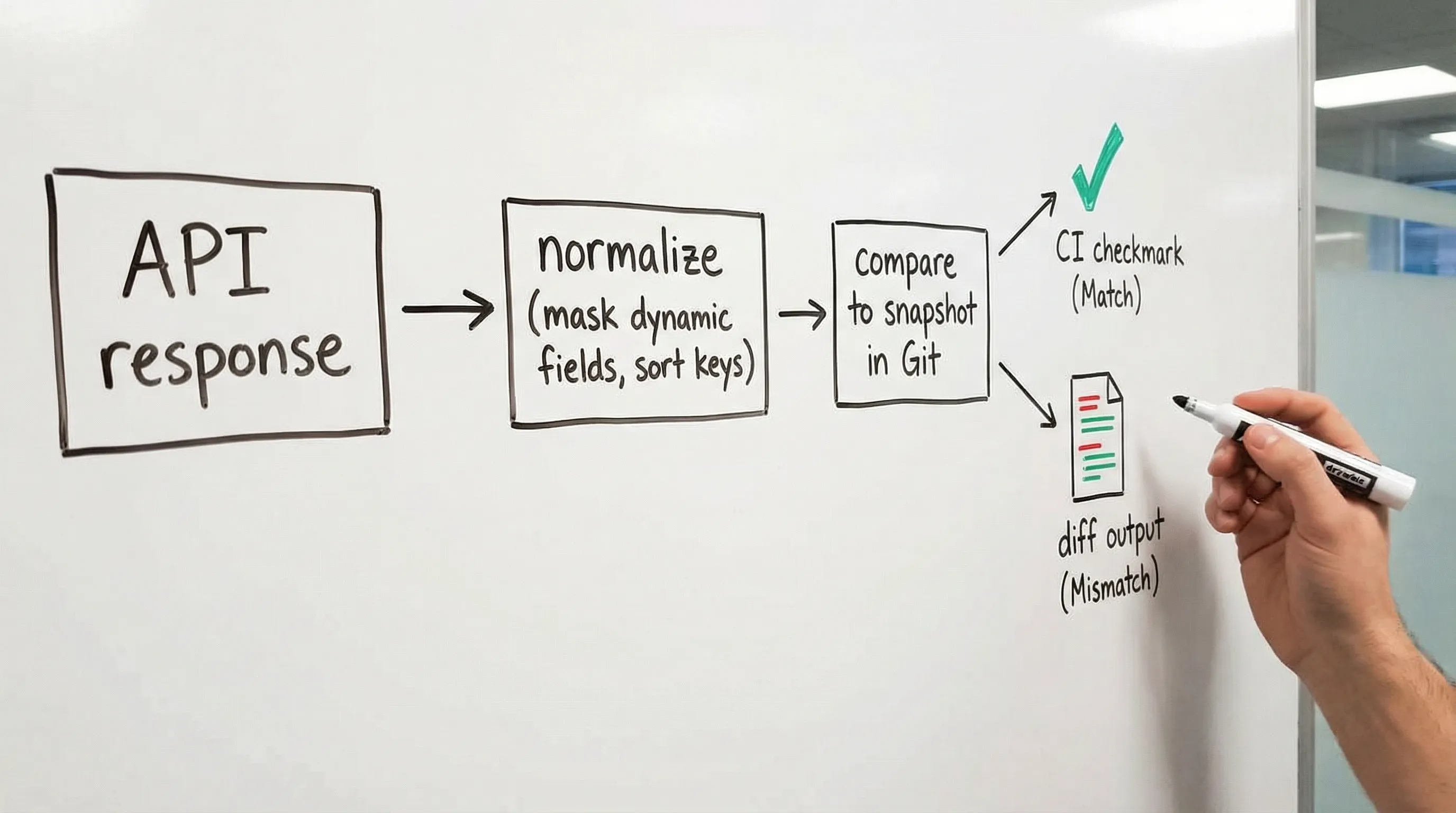
In practice, the snapshot you store should be a canonicalized and redacted view of the response.
Typical normalization rules:
- Delete dynamic fields (
traceId,createdAt,updatedAt) - Sort object keys (canonical JSON)
- Sort arrays by a stable key (when order is not semantically meaningful)
- Round floats to a tolerance (only when appropriate)
Those rules fit in one small jq file that CI and your laptop both run, so the snapshot you commit and the snapshot CI builds come out of the same filter:
# snapshots/normalize.jq
# 1. Drop the fields that change on every call.
del(.traceId, .generatedAt)
# 2. Give every unordered array a stable order, then drop volatile keys inside it.
| .results |= (sort_by(.id) | map(del(.fetchedAt, .internalId)))
Apply it with jq -S -f snapshots/normalize.jq. The builtin del removes a key and its corresponding value from an object; sort_by(f) compares two elements by comparing the result of f on each element, so sort_by(.id) puts a list in a repeatable order whatever the server returns; and -S outputs the fields of each object with the keys in sorted order. Nothing in the file is specific to a runner, so the rules travel with the payload when you change tools.
Here is an example flow that captures a response, then compares a normalized view against a checked-in snapshot file. The normalization can be done in CI with standard tools (for example jq) and the snapshot stays small and reviewable.
# flows/billing/get-entitlements.snapshot.yml

env:
  BASE_URL: '{{BASE_URL}}'
  ACCESS_TOKEN: '{{ACCESS_TOKEN}}'

flows:
  - name: EntitlementsSnapshot
    steps:
      - request:
          name: GetEntitlements
          method: GET
          url: '{{BASE_URL}}/v1/billing/entitlements'
          headers:
            Authorization: Bearer {{ACCESS_TOKEN}}

      - js:
          name: ValidateAndCapture
          code: |
            export default function(ctx) {
              const resp = ctx.GetEntitlements?.response;
              if (resp?.status !== 200) throw new Error(`Expected 200, got ${resp?.status}`);
              return { raw: resp.body };
            }
          depends_on: GetEntitlements
And a CI-side canonicalization + diff step (illustrative):
# .github/workflows/api.yml (excerpt)
- name: Run flow
  run: devtools run flows/billing/get-entitlements.snapshot.yml --report-junit reports/junit.xml --report-json reports/run.json

- name: Canonicalize response and diff snapshot
  run: |
    cat reports/run.json \
      | jq '.steps[] | select(.name=="GetEntitlements") | .response.body' \
      | jq 'del(.traceId, .generatedAt)
            | .plans |= (sort_by(.planId))' \
      | jq -S . > artifacts/entitlements.canon.json

    diff -u snapshots/entitlements.canon.json artifacts/entitlements.canon.json
This pattern keeps the snapshot mechanism tool-agnostic and extremely reviewable in Git. You store:
- the flow YAML
- the snapshot JSON (canonical)
- the normalization rules (in CI scripts)
If you instead keep snapshots inside UI tools or opaque formats, you often get either noisy diffs or no diffs.
Schema vs snapshot in CI: trade-offs that matter
| Dimension | Schema testing | Snapshot testing |
|---|---|---|
| Best at | Preventing breaking contract changes | Catching subtle payload regressions |
| Maintenance | Usually low | Can be high without normalization |
| CI failure signal | “field missing/type wrong” | “these values changed” (can be noisy) |
| Review in PR | Small YAML diffs | JSON diffs can be large but precise |
| Flake risk | Low | Medium to high unless deterministic |
| Works well for | Broad endpoint coverage | A few critical, complex endpoints |
The hybrid strategy that usually works
Most teams land on a hybrid, whether they call it that or not:
- Schema checks everywhere (broad coverage, contract guardrails)
- Snapshots only where they pay for themselves (complex nested payloads)
- Targeted assertions around invariants (the “must never change” rules)
The important detail is “targeted”. Snapshots should not be your default assertion style for every endpoint, and the assertion style is one of the things teams should agree on, as Dev Tools for API Testing explains.
Hybrid pattern: schema + invariants + selective snapshotting
Here’s a concrete YAML flow that chains requests, does contract-style checks, and snapshots only the part that is expensive to assert manually.
Scenario: create an order, fetch it back, confirm the contract is intact, then snapshot the normalized lineItems block.
# flows/orders/order.hybrid.yml

env:
  BASE_URL: '{{BASE_URL}}'
  ACCESS_TOKEN: '{{ACCESS_TOKEN}}'

flows:
  - name: OrderHybrid
    steps:
      - request:
          name: CreateOrder
          method: POST
          url: '{{BASE_URL}}/v1/orders'
          headers:
            Authorization: Bearer {{ACCESS_TOKEN}}
            Content-Type: application/json
          body:
            currency: USD
            items:
              - sku: "SKU-123"
                qty: 2
              - sku: "SKU-456"
                qty: 1

      - js:
          name: ValidateCreate
          code: |
            export default function(ctx) {
              const resp = ctx.CreateOrder?.response;
              if (resp?.status !== 201) throw new Error(`Expected 201, got ${resp?.status}`);
              if (typeof resp?.body?.id !== 'string') throw new Error("id not string");
              if (typeof resp?.body?.total !== 'number') throw new Error("total not number");
              return { orderId: resp.body.id };
            }
          depends_on: CreateOrder

      - request:
          name: GetOrder
          method: GET
          url: '{{BASE_URL}}/v1/orders/{{CreateOrder.response.body.id}}'
          headers:
            Authorization: Bearer {{ACCESS_TOKEN}}
          depends_on: ValidateCreate

      - js:
          name: ValidateOrderContract
          code: |
            export default function(ctx) {
              const resp = ctx.GetOrder?.response;
              if (resp?.status !== 200) throw new Error(`Expected 200, got ${resp?.status}`);
              const body = resp?.body;

              // Schema-ish contract checks
              if (body?.id !== ctx.CreateOrder?.response?.body?.id) throw new Error("id mismatch");
              if (body?.currency !== "USD") throw new Error("currency mismatch");
              if (!Array.isArray(body?.lineItems)) throw new Error("lineItems not array");

              // Invariants that should never drift
              for (const item of body.lineItems) {
                if (!item.sku) throw new Error("lineItem missing sku");
                if (typeof item.qty !== 'number' || item.qty < 1) {
                  throw new Error(`lineItem bad qty: ${item.qty}`);
                }
              }
              return { lineItems: body.lineItems };
            }
          depends_on: GetOrder
Then snapshot only lineItems after canonicalization:
# CI excerpt (illustrative)
- name: Snapshot line items
  run: |
    cat reports/run.json \
      | jq '.steps[] | select(.name=="GetOrder") | .response.body.lineItems' \
      | jq 'sort_by(.sku) | map(del(.addedAt, .internalId))' \
      | jq -S . > artifacts/order.lineItems.canon.json

    diff -u snapshots/order.lineItems.canon.json artifacts/order.lineItems.canon.json
What you get:
- Schema-like checks protect the contract across environments.
- Targeted invariants prevent “silent” semantic changes.
- Snapshot covers the expensive nested structure without snapshotting volatile fields.
Copy-paste templates: a schema test and a snapshot test
Three files are the whole kit: a contract flow that runs on every pull request, a snapshot job that goes red only when a value really moved, and the jq filter above that keeps the stored snapshot canonical. DevTools flows are YAML files that run in CI with JUnit reports, so every part of this lives in Git beside the code it covers.
Schema test template
Save this as flows/users/user.contract.yml. A request node takes an assertions list of expressions over response.status and response.body, which keeps the contract checks declarative instead of hiding them in a script.
# flows/users/user.contract.yml

env:
  BASE_URL: '{{BASE_URL}}'
  ACCESS_TOKEN: '{{ACCESS_TOKEN}}'

flows:
  - name: UserContract
    variables:
      - name: TEST_USER_ID
        value: '{{TEST_USER_ID}}'
    steps:
      - request:
          name: GetUser
          method: GET
          url: '{{BASE_URL}}/v1/users/{{TEST_USER_ID}}'
          headers:
            Authorization: Bearer {{ACCESS_TOKEN}}
          assertions:
            # Presence and shape: the contract, not the content.
            - response.status == 200
            - response.body.id != null
            - response.body.email != null
            - response.body.createdAt != null
            - response.body.profile.displayName != null
            # An invariant that must survive every additive change.
            - response.body.roles.length > 0
Run it with the same command locally and in CI, where the --report junit: flag writes XML for CI systems like Jenkins, GitLab CI and GitHub Actions:
devtools flow run flows/users/user.contract.yml --report junit:reports/contract.xml
Add one file per endpoint group and keep the list of assertions short. Because they name fields instead of whole bodies, a new optional field in the response does not turn the suite red, which is the same reasoning a Contract Testing vs End-to-End API Testing decision applies one level up.
Snapshot test template
Two files again: the flow that fetches the payload and guards the invariants, and the CI job that canonicalizes the response and compares it with the golden file in Git.
# flows/search/search.snapshot.yml

env:
  BASE_URL: '{{BASE_URL}}'
  ACCESS_TOKEN: '{{ACCESS_TOKEN}}'

flows:
  - name: SearchSnapshot
    steps:
      - request:
          name: Search
          method: GET
          url: '{{BASE_URL}}/v1/search?q=api'
          headers:
            Authorization: Bearer {{ACCESS_TOKEN}}
          assertions:
            - response.status == 200
            - response.body.results.length > 0

      - js:
          name: CanonicalSearch
          code: |
            export default function(context) {
              const body = context.Search?.response?.body;
              const canonical = {
                total: body.total,
                results: [...body.results]
                  .sort((a, b) => a.id.localeCompare(b.id))
                  .map(({ fetchedAt, internalId, ...rest }) => rest),
              };
              console.log(JSON.stringify(canonical, null, 2));
              return { canonical };
            }
          depends_on: Search
A JavaScript node reads the earlier node outputs from context, returns an object to the nodes after it, and its console.log output appears in the execution results, so a failed run shows the canonical view without a second tool.
The CI job runs the contract first on purpose. A broken contract then fails the job before the snapshot diff prints a hundred lines that all trace back to one renamed field:
# .github/workflows/api-snapshot.yml (excerpt)
- name: Contract and invariants
  run: devtools flow run flows/search/search.snapshot.yml --report junit:reports/contract.xml

- name: Capture and canonicalize
  run: |
    mkdir -p artifacts
    curl -sS "$BASE_URL/v1/search?q=api" -H "Authorization: Bearer $ACCESS_TOKEN" \
      | jq -S -f snapshots/normalize.jq > artifacts/search.canon.json

- name: Compare with the golden file
  run: diff -u snapshots/search.canon.json artifacts/search.canon.json
No custom comparator is needed: an exit status of 1 from diff means some differences were found, which is all a CI step needs to fail. Reviewing that failure is then an ordinary code review, and a Git Workflow for YAML API Tests settles who has to approve a snapshot change before it merges.
One worked example: the assertion and the golden file side by side
The assertion in the flow above says the endpoint still answers and still returns results:
          assertions:
            - response.status == 200
            - response.body.results.length > 0
The golden file beside it records what those results held the last time a reviewer approved them:
{
  "results": [
    { "id": "doc-001", "score": 0.91, "title": "API testing in CI" },
    { "id": "doc-002", "score": 0.74, "title": "Schema vs snapshot" }
  ],
  "total": 2
}
Rename one title and the two halves report different things. The assertion stays green, because the endpoint still answers with results. The diff goes red and names the field:
--- snapshots/search.canon.json
+++ artifacts/search.canon.json
@@
-    { "id": "doc-002", "score": 0.74, "title": "Schema vs snapshot" }
+    { "id": "doc-002", "score": 0.74, "title": "Schema versus snapshot" }
That is the division of labor this guide argues for, visible on one endpoint: the contract guards the shape, the snapshot guards the values, and neither one goes red for the other's reasons.
CI workflow recommendations (YAML-first, Git-first)
Keep contract checks fast, run them on every PR
A common split that works:
- PR checks: auth + smoke flows + schema/invariant checks
- Post-merge or nightly: deeper suites, more snapshots
If you need a ready-made CI setup, use the copy-paste workflows in: API regression testing in GitHub Actions and GitHub Actions for YAML API tests.
Treat snapshots like code, not like output
Rules that reduce snapshot pain:
- Store canonical snapshots in
snapshots/next to flows. - Make snapshot updates explicit (separate PR, CODEOWNERS review).
- Never auto-update snapshots on CI failure.
Pin versions so “snapshot drift” is not tool drift
If your runner, serializer, or CI image changes, snapshots can change even when the API did not.
Pin your CI stack (runner OS, actions, tool versions) to avoid accidental diffs. See: pinning GitHub Actions and tool versions.
Postman/Newman/Bruno comparison (practical, not ideological)
Schema and snapshot testing are possible in all of these ecosystems, but the day-to-day workflow differs.
Postman + Newman
- Schema checks typically live in JS scripts inside collection tests.
- Snapshots usually become “custom code” because collections are not designed around Git-friendly golden files.
- Diffs are often noisy because the source of truth is a collection JSON export plus embedded scripts.
Newman is CI-friendly, but you are still carrying the collection format and a scripting layer.
If you are migrating, DevTools has practical guides: Migrate from Postman to DevTools and Newman alternative for CI: DevTools CLI.
Bruno
Bruno improves Git-friendliness relative to Postman, but it is still a tool-specific format. If your goal is to keep tests “as code” in a format every engineer can review, native YAML has fewer moving parts.
YAML-first flows (DevTools-style)
The material advantage in CI is not “more features”. It is:
- readable changes in pull requests
- deterministic formatting and stable diffs
- request chaining and assertions expressed declaratively
If you generate flows from real traffic (HAR) and then commit the YAML, you also get a clean provenance from “what happened in the browser” to “what CI runs”.
Frequently Asked Questions
Is schema testing enough for API regression in CI? Schema testing is enough to catch contract breaks, but it often misses subtle regressions in complex nested payloads. That is where selective snapshots help.
Why do snapshot tests get flaky in CI? Snapshots get flaky when they capture non-deterministic fields (timestamps, UUIDs), unordered collections, or environment-specific values. Canonicalize and redact before comparing.
Should we snapshot entire API responses? Usually no. Snapshot only the parts where the ROI is high, and keep invariants (IDs, currency, counts, enums) as explicit assertions.
How do we review snapshot updates safely? Treat snapshots like code: store canonicalized JSON in Git, require PR review for changes, and avoid auto-updating snapshots on failures.
Can we run schema checks and snapshots in the same pipeline? Yes. Many teams run contract checks on every PR and reserve snapshot-heavy suites for post-merge or nightly jobs to keep PR signal fast and stable.
Where should the golden file live? Next to the flow it belongs to, in the same pull request: flows/search/search.snapshot.yml, snapshots/search.canon.json, and the snapshots/normalize.jq filter that produced it. A snapshot change is then a reviewable diff with an author and a reason.
Can we use Jest snapshots for API responses in CI? Yes, and one guard is built in: as of Jest 20, snapshots in Jest are not automatically written when Jest is run in a CI system without explicitly passing --updateSnapshot. The normalization rules above still apply. A Jest snapshot of a raw response with a timestamp inside it fails on the second run wherever it runs.
How do we update a snapshot on purpose? Regenerate it in its own commit and review the diff like code. In Jest that is a run with --updateSnapshot, or the equivalent single-character -u flag. With the jq pipeline it is the command CI already runs, written over the golden file instead of an artifact: curl ... | jq -S -f snapshots/normalize.jq > snapshots/search.canon.json.
Put schema and snapshots under Git control with YAML flows
If your current setup relies on UI-locked collections or custom formats, you end up debugging CI failures without clean diffs. DevTools is built for the opposite workflow: generate API flows from real browser traffic (HAR), export native YAML flows, review changes in PRs, and run them locally or in CI.
- Start from real traffic: Generate a HAR file in Chrome (Safely)
- Run YAML flows in CI as a Newman replacement: DevTools CLI guide
- Learn YAML patterns that keep tests deterministic: Deterministic API Assertions
- Chain schema and snapshot checks into multi-step workflows: End-to-End API Testing: The Complete Guide