 Star on GitHub
JSON Assertion Patterns for API Tests: A Practical Guide (with YAML Examples)
When you test an API with JSON responses, the hard part is rarely “did it return 200?” The hard part is writing assertions that are strict enough to catch regressions, but not so brittle that they fail on harmless variation (timestamps, ordering, new fields, pagination tokens). In CI, brittle JSON assertions turn into noise, and noise trains teams to ignore failures.
This guide is a set of practical JSON assertion patterns you can apply in YAML-based API tests, with examples you can review in pull requests and run deterministically in CI.
Notes on examples: The YAML snippets below are intentionally “pattern-first”. Different runners use different keys, but the core ideas (JSONPath selection, extract then chain, subset matching, normalization) carry across. DevTools is YAML-first and designed for this style of workflow, rather than UI-locked tests or JS scripts embedded in Postman collections.
The core idea: assert invariants, not representations
A good JSON assertion answers: “What must stay true for clients to work?” not “Did I get the exact same payload bytes?”
That usually means:
- Prefer presence, type, and format assertions over full-body equality.
- Assert stable identifiers and relationships (IDs, references, ownership, authorization).
- Treat the response as a contract boundary: check what clients rely on.
If you want a formal reference for JSONPath behavior, use the standard: RFC 9535 (JSONPath).
A quick taxonomy of JSON assertions
Here is a useful mental model for picking the right strictness level:
| Pattern | Best for | What it catches | Common flake source | Typical fix |
|---|---|---|---|---|
| Presence/type checks | Most endpoints | Missing fields, wrong types | null vs missing, polymorphic fields | Explicitly allow variants |
| Subset object match | Response “shape” | Contract drift without overfitting | Extra fields, ordering | Only match stable subset |
| Array contains / set match | Lists and collections | Missing critical items | Unordered arrays | Canonicalize/sort or assert membership |
| Format assertions | IDs, emails, timestamps | Wrong encoding/format | Timezones, precision | Validate pattern, not exact value |
| Numeric tolerance | Prices, rates, metrics | Meaningful drift | Floating point / rounding | Assert ranges or epsilon |
| Snapshot (normalized) | Complex nested payloads | Subtle representation changes | Volatile fields | Normalize before compare |
Pattern 1: “Status + content-type + minimal body contract”
Start with the cheap, high-signal checks: status code and content-type, then a small set of JSON invariants.
flows:
  - name: UserContract
    steps:
      - request:
          name: GetUser
          method: GET
          url: '{{BASE_URL}}/v1/users/{{USER_ID}}'
          headers:
            Authorization: Bearer {{TOKEN}}

      - js:
          name: ValidateUserContract
          code: |
            export default function(ctx) {
              const resp = ctx.GetUser?.response;
              if (resp?.status !== 200) throw new Error(`Expected 200, got ${resp?.status}`);
              const ct = resp?.headers?.["content-type"];
              if (!ct?.includes("application/json")) throw new Error(`Bad content-type: ${ct}`);
              const body = resp?.body;
              if (typeof body?.id !== 'string') throw new Error("id not string");
              if (typeof body?.email !== 'string') throw new Error("email not string");
              if (typeof body?.createdAt !== 'string') throw new Error("createdAt not string");
              return { validated: true };
            }
          depends_on: GetUser
Why this works in Git and CI:
- Small diffs when the API changes.
- Less temptation to embed complex logic (for example JS in Postman tests).
- Reviewers can see exactly which contract you care about.
Pattern 2: Assert types and allowed variants (especially null vs missing)
A classic regression is changing field: null into a missing field, or vice versa. Another is polymorphism, for example owner is sometimes an object, sometimes a string ID.
Be explicit about what you accept.
flows:
  - name: ProjectContract
    steps:
      - request:
          name: GetProject
          method: GET
          url: '{{BASE_URL}}/v1/projects/{{PROJECT_ID}}'

      - js:
          name: ValidateProjectVariants
          code: |
            export default function(ctx) {
              const resp = ctx.GetProject?.response;
              if (resp?.status !== 200) throw new Error(`Expected 200, got ${resp?.status}`);
              const body = resp?.body;

              // archivedAt: must be null or an ISO timestamp string
              const archived = body?.archivedAt;
              if (archived !== null && archived !== undefined) {
                if (typeof archived !== 'string' || !/^\d{4}-\d{2}-\d{2}T/.test(archived)) {
                  throw new Error(`archivedAt bad format: ${archived}`);
                }
              }

              // owner: must be a string ID or an object
              const owner = body?.owner;
              if (typeof owner !== 'string' && typeof owner !== 'object') {
                throw new Error(`owner unexpected type: ${typeof owner}`);
              }
              return { validated: true };
            }
          depends_on: GetProject
If you do not encode these variants, your tests oscillate between being too strict (false failures) and too loose (missing real contract drift).
Pattern 3: Subset matching for objects (avoid full-body equals)
Full response equality is attractive because it is one line, but it is rarely stable in CI once the payload includes:
- timestamps
- request IDs
- feature flags
- new optional fields
Instead, match a subset you care about.
flows:
  - name: WidgetSubset
    steps:
      - request:
          name: CreateWidget
          method: POST
          url: '{{BASE_URL}}/v1/widgets'
          body:
            name: "ci-smoke"
            color: "blue"

      - js:
          name: ValidateSubset
          code: |
            export default function(ctx) {
              const resp = ctx.CreateWidget?.response;
              if (resp?.status !== 201) throw new Error(`Expected 201, got ${resp?.status}`);
              const body = resp?.body;
              if (body?.name !== "ci-smoke") throw new Error("name mismatch");
              if (body?.color !== "blue") throw new Error("color mismatch");
              return { validated: true };
            }
          depends_on: CreateWidget
This pattern is also where YAML-first workflows tend to beat Postman/Newman in practice: Postman collections often push teams into JS test scripts to do partial matching, which then becomes opaque in code review.
Pattern 4: Extract, then assert again (request chaining as a first-class pattern)
Many “JSON assertions” are really assertions about relationships across requests.
Example: create a resource, capture its ID, fetch it, and assert persistence.
flows:
  - name: OrderChaining
    steps:
      - request:
          name: CreateOrder
          method: POST
          url: '{{BASE_URL}}/v1/orders'
          body:
            sku: "SKU-123"
            qty: 2

      - js:
          name: ValidateCreate
          code: |
            export default function(ctx) {
              const resp = ctx.CreateOrder?.response;
              if (resp?.status !== 201) throw new Error(`Expected 201, got ${resp?.status}`);
              if (typeof resp?.body?.id !== 'string') throw new Error("id not string");
              return { orderId: resp.body.id };
            }
          depends_on: CreateOrder

      - request:
          name: GetOrder
          method: GET
          url: '{{BASE_URL}}/v1/orders/{{CreateOrder.response.body.id}}'
          depends_on: ValidateCreate

      - js:
          name: ValidateOrder
          code: |
            export default function(ctx) {
              const resp = ctx.GetOrder?.response;
              if (resp?.status !== 200) throw new Error(`Expected 200, got ${resp?.status}`);
              if (resp?.body?.sku !== "SKU-123") throw new Error("sku mismatch");
              if (resp?.body?.qty !== 2) throw new Error("qty mismatch");
              return { validated: true };
            }
          depends_on: GetOrder
Two practical rules for chaining:
- Reference only what you need downstream (IDs, tokens, ETags) via
{{NodeName.response.body.field}}. - Keep the dependent request adjacent in the YAML file so the data flow is obvious in diffs.
Pattern 5: Array assertions without depending on ordering
Unstable ordering is one of the fastest ways to create flaky tests.
Prefer these strategies, in order:
Assert length bounds, not exact length
flows:
  - name: EventsList
    steps:
      - request:
          name: ListEvents
          method: GET
          url: '{{BASE_URL}}/v1/events'
          query_params:
            limit: "50"

      - js:
          name: ValidateEventsList
          code: |
            export default function(ctx) {
              const resp = ctx.ListEvents?.response;
              if (resp?.status !== 200) throw new Error(`Expected 200, got ${resp?.status}`);
              const items = resp?.body?.items;
              if (!Array.isArray(items)) throw new Error("items is not an array");
              if (items.length < 1) throw new Error("items empty");
              if (items.length > 50) throw new Error(`Too many items: ${items.length}`);
              return { count: items.length };
            }
          depends_on: ListEvents
Assert membership by key (contains an item with an ID)
flows:
  - name: WidgetMembership
    steps:
      - request:
          name: ListWidgets
          method: GET
          url: '{{BASE_URL}}/v1/widgets'

      - js:
          name: ValidateMembership
          code: |
            export default function(ctx) {
              const resp = ctx.ListWidgets?.response;
              if (resp?.status !== 200) throw new Error(`Expected 200, got ${resp?.status}`);
              const ids = resp?.body?.items?.map(i => i.id);
              if (!ids?.includes(ctx.widgetId)) {
                throw new Error(`Widget ${ctx.widgetId} not found in list`);
              }
              return { found: true };
            }
          depends_on: ListWidgets
Canonicalize before asserting deep equality
If you truly need deep equality on arrays, sort them by a stable key first. Do this either:
- in the API (recommended for deterministic outputs), or
- in a normalization step in CI (for example
jqsort), then compare.
For JSON normalization tooling, jq is the common baseline: stedolan/jq.
Pattern 6: Numeric assertions with tolerance
If you assert exact floating point values, your tests will fail for reasons unrelated to regressions (serialization differences, rounding, platform variance).
Instead, assert ranges or an epsilon.
flows:
  - name: QuotePricing
    steps:
      - request:
          name: GetQuote
          method: GET
          url: '{{BASE_URL}}/v1/quote'
          query_params:
            sku: SKU-123

      - js:
          name: ValidatePrice
          code: |
            export default function(ctx) {
              const resp = ctx.GetQuote?.response;
              if (resp?.status !== 200) throw new Error(`Expected 200, got ${resp?.status}`);
              const price = resp?.body?.price;
              if (typeof price !== 'number') throw new Error("price is not a number");
              if (price < 9.99 || price > 10.01) {
                throw new Error(`Price out of range: ${price}`);
              }
              return { price };
            }
          depends_on: GetQuote
In CI, ranges are usually easier to reason about in reviews than “approx” helpers hidden in code.
Pattern 7: Timestamp assertions that still catch regressions
Do not assert exact timestamps unless you control the clock.
Better options:
- Validate format (ISO 8601 shape).
- Assert monotonic relationships (
updatedAt >= createdAt). - Assert “recentness” relative to a request-scoped start time (if your runner supports capturing time).
Format-only example:
flows:
  - name: AuditTimestamp
    steps:
      - request:
          name: GetAuditEntry
          method: GET
          url: '{{BASE_URL}}/v1/audit/{{ENTRY_ID}}'

      - js:
          name: ValidateTimestamp
          code: |
            export default function(ctx) {
              const resp = ctx.GetAuditEntry?.response;
              if (resp?.status !== 200) throw new Error(`Expected 200, got ${resp?.status}`);
              const ts = resp?.body?.timestamp;
              if (!/^\d{4}-\d{2}-\d{2}T\d{2}:\d{2}:\d{2}/.test(ts)) {
                throw new Error(`Bad timestamp format: ${ts}`);
              }
              return { timestamp: ts };
            }
          depends_on: GetAuditEntry
If you need deeper time semantics, consider pushing those assertions into a contract test at a lower layer, or inject a fixed clock in test environments.
Pattern 8: Error responses, negative assertions, and “must not leak” checks
Teams often under-test error payloads, then accidentally break clients that rely on stable error codes, or worse, leak internal details.
Write explicit assertions for failure modes.
flows:
  - name: ErrorContract
    steps:
      - request:
          name: UnauthenticatedRequest
          method: GET
          url: '{{BASE_URL}}/v1/private'

      - js:
          name: ValidateErrorResponse
          code: |
            export default function(ctx) {
              const resp = ctx.UnauthenticatedRequest?.response;
              if (resp?.status !== 401) throw new Error(`Expected 401, got ${resp?.status}`);
              const err = resp?.body?.error;
              if (err?.code !== "UNAUTHENTICATED") throw new Error(`Wrong error code: ${err?.code}`);
              if (typeof err?.message !== 'string') throw new Error("error.message not string");
              if (err?.details !== undefined) throw new Error("error.details should not exist");
              return { validated: true };
            }
          depends_on: UnauthenticatedRequest
These tests are extremely reviewable in YAML, and they often get buried when Postman collections rely on scattered JS snippets per request.
Pattern 9: Schema assertions, where they help, and where they hurt
Schema checks are great for broad coverage and for catching contract drift. They are less great at encoding “business meaning”.
Use them strategically:
- Validate “shape” and types across many endpoints.
- Keep business-critical assertions as explicit JSONPath checks.
If your org already publishes OpenAPI, wire schema validation into CI and treat it as a gate: OpenAPI Specification.
For JSON Schema references: json-schema.org.
A practical hybrid in YAML is:
- schema validate (broad)
- plus a small set of hand-written invariants (deep)
Pattern 10: Snapshot testing, but only after normalization
Snapshot tests can be valuable when the payload is complex and you care about the exact representation. But raw snapshots are flaky unless you normalize.
Normalization usually includes:
- removing volatile keys (
requestId, timestamps, trace IDs) - sorting arrays by stable keys
- canonicalizing numbers and nulls if needed
Example pattern:
flows:
  - name: DashboardSnapshot
    steps:
      - request:
          name: GetDashboard
          method: GET
          url: '{{BASE_URL}}/v1/dashboard'

      - js:
          name: NormalizeAndValidate
          code: |
            export default function(ctx) {
              const resp = ctx.GetDashboard?.response;
              if (resp?.status !== 200) throw new Error(`Expected 200, got ${resp?.status}`);
              const body = { ...resp?.body };

              // Drop volatile fields
              delete body.requestId;
              delete body.generatedAt;

              // Sort widgets by stable key
              if (Array.isArray(body.widgets)) {
                body.widgets.sort((a, b) => a.id.localeCompare(b.id));
              }

              return { normalized: body };
            }
          depends_on: GetDashboard
The js: node returns the normalized payload, which you can then compare to a golden snapshot file in CI (for example with jq and diff).
Even if your exact runner syntax differs, the key is process: normalized snapshots stored in Git are reviewable and deterministic, raw snapshots are not.
What changes with YAML-first workflows (DevTools vs Postman/Newman vs Bruno)
At an assertion-pattern level, the differences show up in day-to-day mechanics:
Postman and Newman
- Postman tests frequently become JS scripts (“Tests” tab) glued to requests.
- Reviews happen on exported collection JSON, where meaningful diffs are hard.
- Newman runs in CI, but you still inherit the format and scripting model.
Bruno
- More local-first than Postman, but it still uses its own file format and conventions.
- Teams often end up with tool-specific DSL decisions that are not shared across the rest of their stack.
DevTools (YAML-first)
- Assertions live as native YAML alongside the flow definition.
- Diffs are readable in PRs, and reviewers can reason about changes without opening a UI.
- Flows are designed to run locally and in CI with deterministic behavior, and chaining is explicit.
If you are already migrating, the most useful discipline is: treat API tests like production code. That means stable file structure, predictable diffs, and CI gates. DevTools has deeper guidance on CI execution in its Newman replacement guide: Newman alternative for CI.
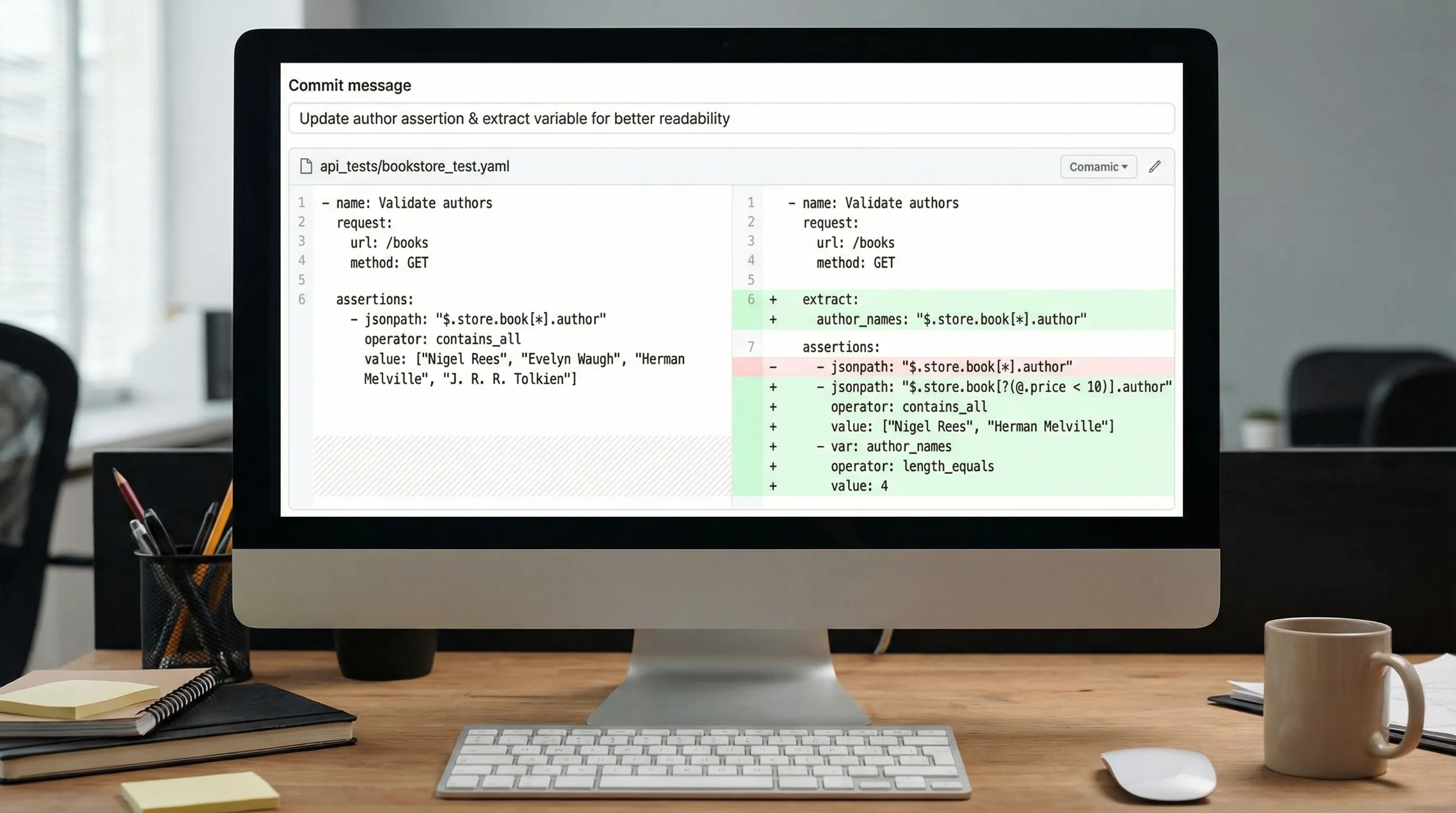
A practical checklist for JSON assertions that survive CI
Before you merge a new or edited assertion, sanity-check it against common failure modes:
- Does this assert a stable invariant, or an incidental value?
- Will this fail if the server adds an optional field?
- Does this depend on array ordering?
- Does this compare floats exactly?
- Does this encode
nullvs missing explicitly where it matters? - If it is a chained flow, is every dependency captured and named?
If you want more on flake sources and how to neutralize them (timestamps, unordered arrays, pagination drift), see: Deterministic API Assertions: Stop Flaky JSON Tests in CI.
Putting it together: a small, reviewable flow
This is the “minimum viable” regression flow many teams converge on: authenticate, create a resource, read it back, validate a stable subset, and assert error behavior.
env:
  BASE_URL: '{{BASE_URL}}'

flows:
  - name: WidgetRegressionFlow
    variables:
      - name: USERNAME
        value: '{{USERNAME}}'
      - name: PASSWORD
        value: '{{PASSWORD}}'
      - name: RUN_ID
        value: '{{RUN_ID}}'
    steps:
      - request:
          name: Login
          method: POST
          url: '{{BASE_URL}}/v1/login'
          body:
            username: '{{USERNAME}}'
            password: '{{PASSWORD}}'

      - js:
          name: ValidateLogin
          code: |
            export default function(ctx) {
              const resp = ctx.Login?.response;
              if (resp?.status !== 200) throw new Error(`Expected 200, got ${resp?.status}`);
              if (typeof resp?.body?.token !== 'string') throw new Error("token not string");
              return { validated: true };
            }
          depends_on: Login

      - request:
          name: CreateWidget
          method: POST
          url: '{{BASE_URL}}/v1/widgets'
          headers:
            Authorization: Bearer {{Login.response.body.token}}
          body:
            name: 'ci-{{RUN_ID}}'
            color: "blue"
          depends_on: ValidateLogin

      - js:
          name: ValidateCreate
          code: |
            export default function(ctx) {
              const resp = ctx.CreateWidget?.response;
              if (resp?.status !== 201) throw new Error(`Expected 201, got ${resp?.status}`);
              if (resp?.body?.color !== "blue") throw new Error("color mismatch");
              return { widgetId: resp.body.id };
            }
          depends_on: CreateWidget

      - request:
          name: GetWidget
          method: GET
          url: '{{BASE_URL}}/v1/widgets/{{CreateWidget.response.body.id}}'
          headers:
            Authorization: Bearer {{Login.response.body.token}}
          depends_on: ValidateCreate

      - js:
          name: ValidateGet
          code: |
            export default function(ctx) {
              const resp = ctx.GetWidget?.response;
              if (resp?.status !== 200) throw new Error(`Expected 200, got ${resp?.status}`);
              if (resp?.body?.id !== ctx.CreateWidget?.response?.body?.id) throw new Error("id mismatch");
              if (!/^ci-/.test(resp?.body?.name)) throw new Error("name should start with ci-");
              if (resp?.body?.color !== "blue") throw new Error("color mismatch");
              return { validated: true };
            }
          depends_on: GetWidget

      - request:
          name: ForbiddenWithoutToken
          method: GET
          url: '{{BASE_URL}}/v1/widgets/{{CreateWidget.response.body.id}}'
          depends_on: ValidateGet

      - js:
          name: ValidateForbidden
          code: |
            export default function(ctx) {
              const resp = ctx.ForbiddenWithoutToken?.response;
              if (resp?.status !== 401) throw new Error(`Expected 401, got ${resp?.status}`);
              if (resp?.body?.error?.code !== "UNAUTHENTICATED") {
                throw new Error(`Wrong error code: ${resp?.body?.error?.code}`);
              }
              return { validated: true };
            }
          depends_on: ForbiddenWithoutToken
That flow is explicit: it chains requests via depends_on, references values directly with {{NodeName.response.body.field}}, and every validation is something a reviewer can understand in seconds.
Where to go next
Once your JSON assertions are stable, the biggest leverage tends to come from process rather than more assertions:
- Run a small smoke shard on every PR, run the full suite post-merge.
- Store YAML flows in Git, and treat changes as code review events.
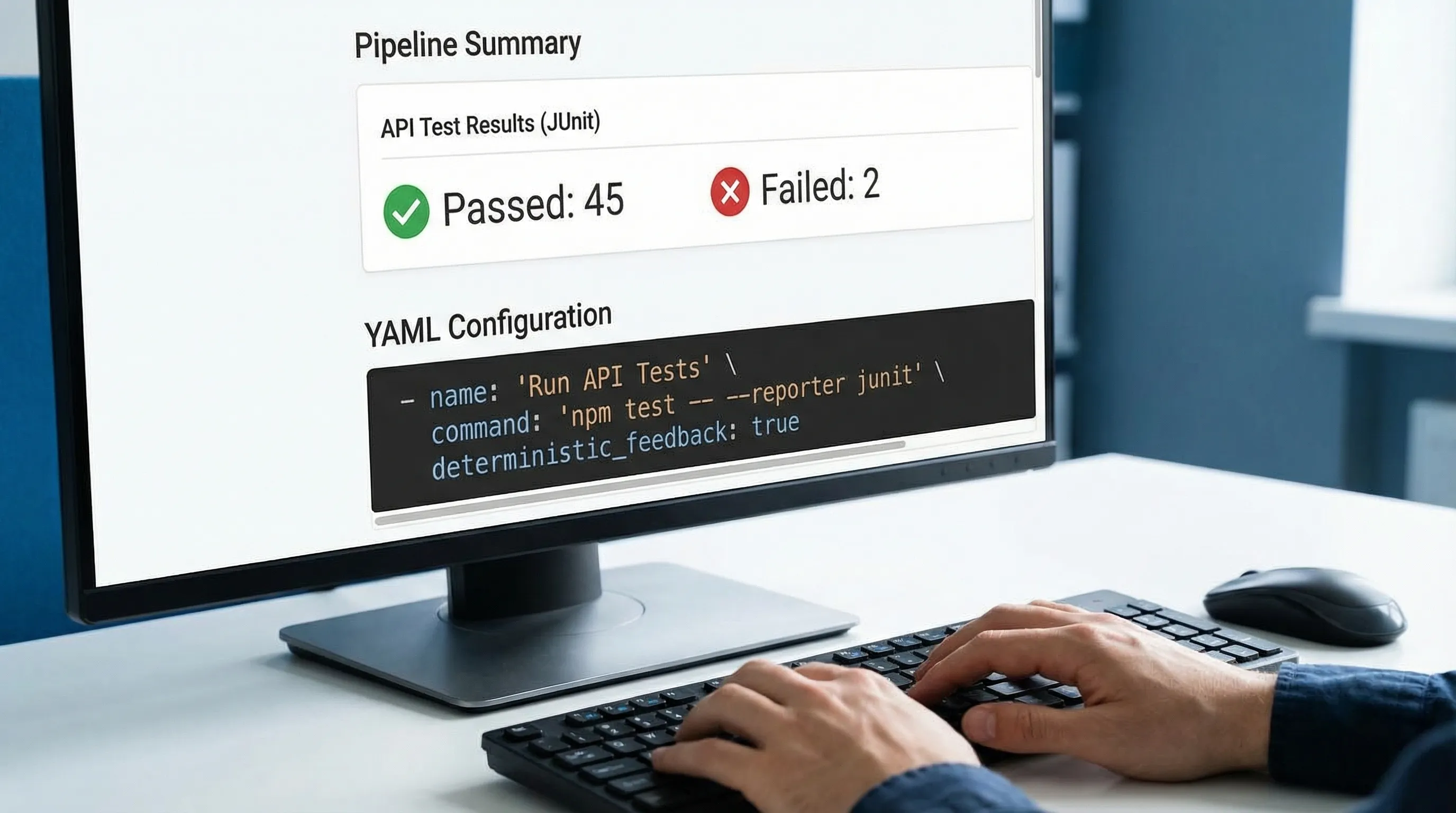
- Emit JUnit and a machine-readable run log as CI artifacts.
For a concrete CI setup, DevTools maintains a practical guide for running YAML flows in GitHub Actions: API regression testing in GitHub Actions.