
 Star on GitHub
Contract Testing vs End-to-End API Testing: A Decision Framework for Engineering Teams
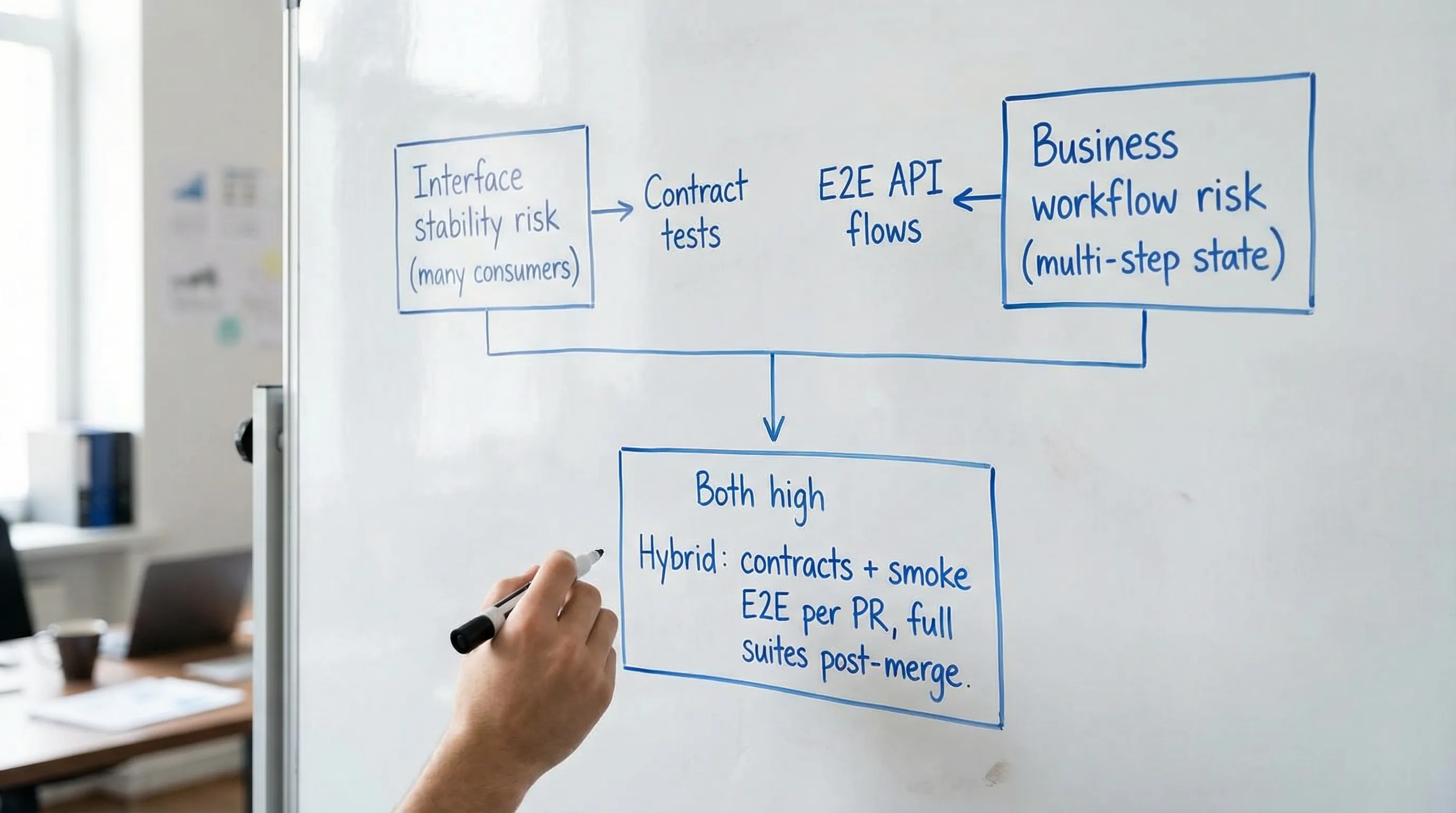
Contract testing and end-to-end (E2E) API testing are often framed as an either-or choice. In mature engineering orgs, they are closer to orthogonal tools: contract tests protect interface stability across producers and consumers, while E2E API workflow tests validate business behavior across real dependencies.
If your team is debating “contract testing vs end-to-end API testing,” the missing piece is usually a decision framework that maps test types to system shape, change velocity, and ownership boundaries, then turns that into a repeatable Git and CI workflow.
This guide is written for experienced developers who want a criteria-based way to design an API test portfolio that scales. It uses a YAML-first mindset throughout: tests are text, reviewed in pull requests, executed deterministically in CI, and chained explicitly via extracted variables.
Definitions that matter in practice
What contract testing actually means (in a CI/CD world)
A contract test verifies that an API provider and its consumers agree on an interface.
In practice, teams implement this in a few common ways:
- Provider-side contract checks: validate that responses match a schema or an OpenAPI/JSON Schema definition, and that required fields, types, and invariants still hold.
- Consumer-driven contract testing (CDCT): consumers publish expectations; providers verify them. Pact is the best-known ecosystem here (Pact docs).
- Compatibility tests around edge semantics: beyond schema, contracts often include things like header requirements, error shapes, pagination rules, idempotency behavior, and rate-limit headers.
What contract tests optimize for:
- Fast feedback on breaking changes
- Stable, diffable interface guarantees
- High coverage across many endpoints without requiring full environment orchestration
What contract tests do not guarantee:
- That multi-step workflows behave correctly end-to-end
- That data consistency holds across services
- That side effects happen (webhooks delivered, emails sent, events published)
What end-to-end API testing means (not UI E2E)
End-to-end API testing in this article means: executing multi-step HTTP workflows that model real product behavior (login, create, transition state, verify downstream effects), with request chaining and assertions on each step.
Key characteristics:
- You test business logic across endpoints, not a single endpoint in isolation.
- You validate sequence + state transitions, not just shapes.
- You run against an environment that approximates production (or at least a fully wired staging stack).
This is distinct from browser UI E2E tests. API E2E flows are generally cheaper and more deterministic than UI E2E, but they still incur environment and data costs.
What each type catches (and what it misses)
The fastest way to align a team is to be explicit about failure modes.
| Failure mode | Contract testing | E2E API workflow testing |
|---|---|---|
| Field renamed/removed | Excellent | Sometimes (only if workflow touches it) |
| Response type changed (string to number) | Excellent | Sometimes |
| Error shape changed (4xx payload contract) | Excellent | Sometimes |
| Auth scope regression | Sometimes (if modeled as contract) | Good |
| State machine regression (valid transitions) | Weak | Excellent |
| Race conditions / eventual consistency issues | Weak | Good (if assertions include polling/consistency) |
| Cross-service integration breaks | Weak | Excellent |
| “It works for our UI” but breaks for external consumers | Excellent (CDCT) | Weak |
| Webhook emitted, message published, side effects happen | Weak | Good (if you verify downstream) |
| Performance budgets / latency regressions | Sometimes | Sometimes |
A useful mental model: contract tests protect compatibility; E2E flows protect behavior.
The decision framework: choose by constraints, not ideology
The right question is not “Which is better?” It is:
- Where do breaking changes come from?
- How many consumers can be broken?
- How often do you ship?
- How expensive is a realistic E2E environment?
- What is the minimal set of workflows that must never break?
Below is a criteria-based framework you can apply per service or per product domain.
Core criteria (the ones that actually change the answer)
1) Team size and ownership boundaries
As team count grows, interface drift becomes more likely because:
- Consumers and providers evolve independently.
- PR review does not naturally include “all consumers.”
- Release trains get asynchronous.
Heuristic:
- Small team, single repo, shared context: E2E flows can cover a lot, contracts still help but are less urgent.
- Multiple teams, multiple repos, platform APIs: contract tests become essential as a coordination mechanism.
2) API count (surface area)
If you have 20 endpoints, you can plausibly maintain E2E coverage plus targeted endpoint checks.
If you have 400 endpoints across many services, E2E alone will not scale because:
- E2E flows are inherently fewer than endpoints.
- E2E failures are harder to localize.
- Test runtime and environment contention balloon.
Contract tests scale better with endpoint count because they are usually single-request checks.
3) Release frequency
The more frequently you deploy, the more you need:
- Fast checks per PR
- Deterministic failures with clear diffs
Contract checks are naturally PR-friendly. E2E flows are also PR-friendly if you keep a small “smoke suite,” but full workflow suites often shift to post-merge or scheduled runs due to runtime and environment costs.
4) Consumer count (and consumer diversity)
Consumer count is the most underestimated variable.
- If the only consumer is your own UI, E2E flows can provide high confidence.
- If you have partner integrations, mobile clients, public SDKs, or multiple internal services consuming the same API, interface stability becomes a product requirement.
Consumer-driven contracts shine here because they encode “what consumers rely on” rather than “what the provider thinks matters.” Martin Fowler’s overview of contract testing is still a good conceptual reference (martinfowler.com).
Decision matrix: what to prioritize first
This matrix is deliberately opinionated. It helps you decide what to build first when you cannot do everything at once.
| Your situation | Contract testing priority | E2E API testing priority | Why |
|---|---|---|---|
| 1 team, <30 endpoints, 1 consumer (your UI), weekly releases | Medium | High | Behavior regressions dominate, and coordination overhead is low |
| 1 team, 100+ endpoints, weekly releases | High | Medium | Surface area grows, E2E cannot touch everything |
| 3+ teams, shared platform API, multiple repos | Very high | Medium | Compatibility breaks become the primary source of incidents |
| Public API with external customers/partners | Very high | Medium | You need explicit compatibility guarantees and versioning discipline |
| Complex workflows (payments, onboarding, provisioning) | High | Very high | Contracts prevent breakage, E2E validates business state transitions |
| Microservices with async messaging (events/webhooks) | High | High | Contracts help, but only workflows catch cross-system side effects |
| High deploy frequency (daily or continuous) | Very high | High (smoke per PR, full suite post-merge) | You need fast PR gates plus deeper confidence |
| Limited staging environment, frequent data contention | High | Low-to-medium | E2E becomes flaky/slow unless you invest in isolation |
If you want a single sentence: contract testing is your breadth strategy; E2E workflow testing is your depth strategy.
A practical scoring model you can apply per service
If your org prefers something closer to an algorithm, use a weighted score.
Step 1: assign a score (1 to 5) for each factor
- Team boundaries: 1 (single team) to 5 (many teams, external consumers)
- API surface area: 1 (<20 endpoints) to 5 (hundreds)
- Release frequency: 1 (monthly) to 5 (daily/continuous)
- Consumer count: 1 (single consumer) to 5 (many)
- Workflow criticality: 1 (simple CRUD) to 5 (payments, provisioning, compliance)
- Environment cost: 1 (easy to spin up) to 5 (hard, shared, flaky)
Step 2: compute two priority scores
You can do this in a spreadsheet, but the intent matters more than the math.
| Factor | Contract weight | E2E weight |
|---|---|---|
| Team boundaries | 3 | 1 |
| API surface area | 2 | 1 |
| Release frequency | 2 | 2 |
| Consumer count | 3 | 1 |
| Workflow criticality | 1 | 3 |
| Environment cost | 1 | -2 |
Interpretation:
- Contract priority increases with boundaries, surface area, consumer count, and ship rate.
- E2E priority increases with workflow criticality and ship rate, but decreases if environments are expensive.
Step 3: turn the result into a test portfolio
Instead of “we chose contract testing,” the output should look like:
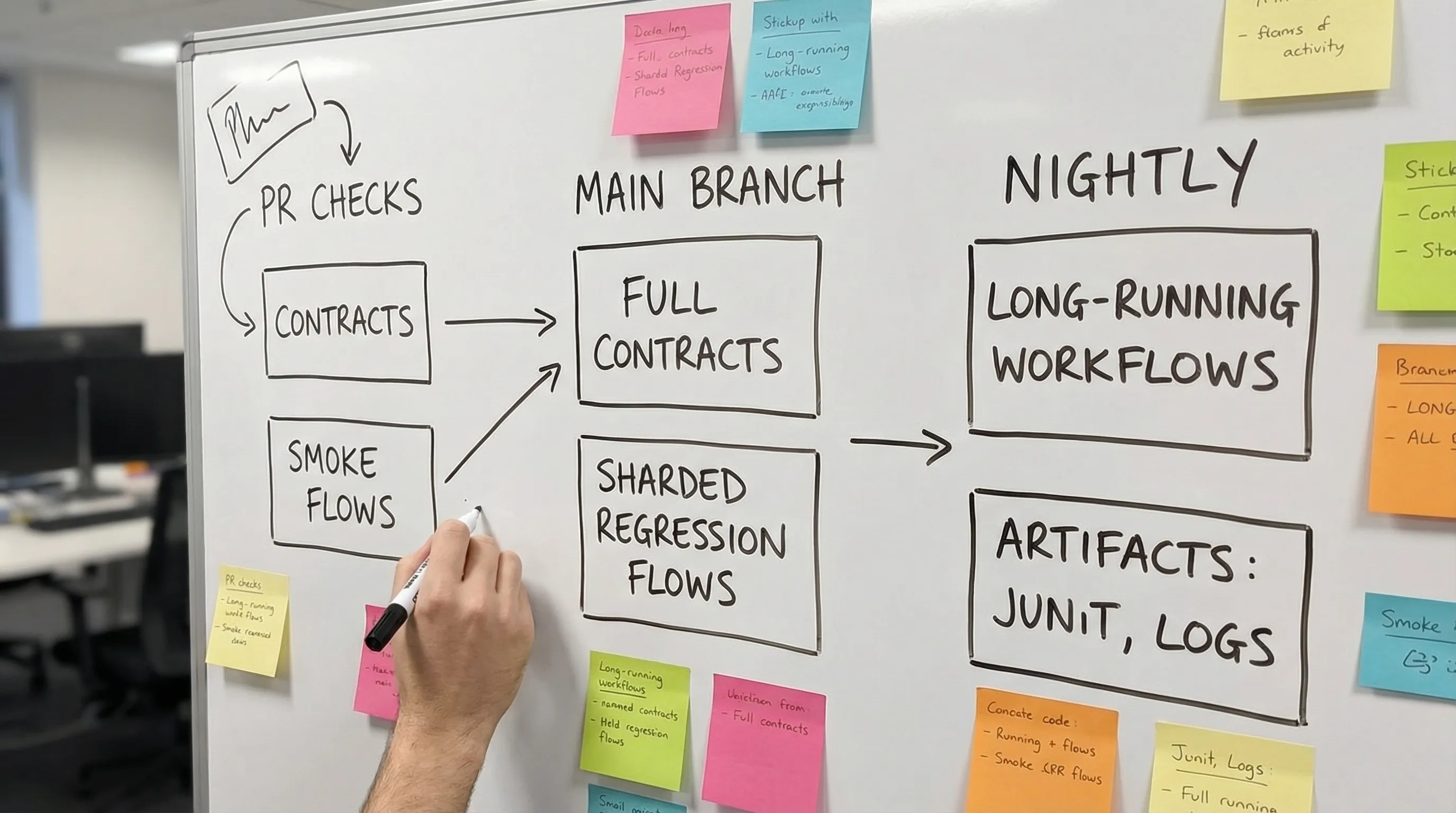
- Per-PR gates:
- Contract checks for changed endpoints
- 5 to 20 E2E smoke flows for critical paths
- Post-merge:
- Full contract suite
- Full E2E regression flows (sharded)
- Nightly:
- Long-running or data-intensive E2E flows
This avoids the common trap where teams pick one method, then discover its blind spots in production.
Where YAML-first testing changes the trade-offs
A lot of “contract vs E2E” debates are really debates about tooling constraints.
UI-locked tools create test artifacts that are hard to govern
With Postman collections:
- The canonical artifact is a JSON export that is not pleasant to review.
- Many teams rely on scripts embedded in the collection, which increases coupling to the tool.
- Newman runs in CI, but the authoring and maintenance loop often stays UI-centric.
With Bruno:
- Tests are local-first and Git-friendly, but the artifact is typically a tool-specific format (for example,
.brufiles). This is still portable within Bruno, but it is not a “native format” widely used outside that ecosystem.
A YAML-first approach changes the workflow:
- Tests are reviewed like code in pull requests.
- Diffs are readable and stable.
- The same artifacts run locally and in CI without “export” steps.
DevTools specifically is built around this model: it converts recorded browser traffic (HAR) into executable YAML flows, supports request chaining via extracted variables, and runs locally or in CI.
The key point for this article: YAML makes it realistic to run both contract checks and E2E flows as code, because the maintenance overhead stays manageable.
How to represent contract checks in YAML (without pretending it’s E2E)
A contract check should be:
- Single request (or very small)
- Explicit about required fields and invariants
- Deterministic (avoid time-dependent assertions)
Below is an example pattern that treats “contract” as “invariants we promise consumers,” not “full schema validation.” This is often enough to prevent breaking changes.
Example: response shape invariants (contract-style)
name: contract.users.get
steps:
  - id: get_user
    request:
      method: GET
      url: "${{ env.API_BASE_URL }}/v1/users/${{ env.USER_ID }}"
      headers:
        authorization: "Bearer ${{ env.API_TOKEN }}"
    expect:
      status: 200
      headers:
        content-type: "application/json"
      json:
        - path: "$.id"
          exists: true
        - path: "$.id"
          type: string
        - path: "$.email"
          exists: true
        - path: "$.email"
          type: string
        - path: "$.createdAt"
          exists: true
        - path: "$.createdAt"
          type: string
Notes:
- This is intentionally not asserting every field. Contracts should focus on what must not break.
- It is stable in CI because it asserts types and presence, not exact values.
Example: error contract invariants (often overlooked)
Breaking error shapes can be as damaging as breaking success payloads.
name: contract.users.get.unauthorized
steps:
  - id: get_user_without_token
    request:
      method: GET
      url: "${{ env.API_BASE_URL }}/v1/users/${{ env.USER_ID }}"
    expect:
      status: 401
      json:
        - path: "$.error"
          exists: true
        - path: "$.error.code"
          exists: true
        - path: "$.error.message"
          exists: true
This type of test pays for itself when you standardize errors across services.
Contract checks that involve chaining (yes, sometimes)
Pure contract tests are often single-request, but there are legitimate cases where you need minimal chaining:
- Fetch an OAuth token, then validate the contract of a protected endpoint
- Create a resource only to guarantee you have a stable ID to test against
The rule: keep it minimal, treat chaining as setup, not the test’s purpose.
How to represent E2E API workflow tests in YAML (and keep them deterministic)
An E2E API flow should be:
- Multi-step
- Explicit about dependencies (extract IDs, reuse tokens)
- Validating state transitions and side effects
Here is a compact example that demonstrates request chaining without recreating a full tutorial.
Example: onboarding workflow (E2E-style)
name: e2e.onboarding.happy_path
steps:
  - id: login
    request:
      method: POST
      url: "${{ env.API_BASE_URL }}/v1/auth/login"
      headers:
        content-type: "application/json"
      body:
        email: "${{ env.TEST_USER_EMAIL }}"
        password: "${{ env.TEST_USER_PASSWORD }}"
    expect:
      status: 200
      json:
        - path: "$.accessToken"
          exists: true
    extract:
      access_token: "$.accessToken"

  - id: create_org
    request:
      method: POST
      url: "${{ env.API_BASE_URL }}/v1/orgs"
      headers:
        authorization: "Bearer ${{ steps.login.extract.access_token }}"
        content-type: "application/json"
      body:
        name: "ci-${{ env.RUN_ID }}"
    expect:
      status: 201
      json:
        - path: "$.id"
          exists: true
    extract:
      org_id: "$.id"

  - id: enable_feature
    request:
      method: POST
      url: "${{ env.API_BASE_URL }}/v1/orgs/${{ steps.create_org.extract.org_id }}/features"
      headers:
        authorization: "Bearer ${{ steps.login.extract.access_token }}"
        content-type: "application/json"
      body:
        key: "advancedMode"
        enabled: true
    expect:
      status: 200
      json:
        - path: "$.key"
          equals: "advancedMode"
        - path: "$.enabled"
          equals: true

  - id: delete_org
    request:
      method: DELETE
      url: "${{ env.API_BASE_URL }}/v1/orgs/${{ steps.create_org.extract.org_id }}"
      headers:
        authorization: "Bearer ${{ steps.login.extract.access_token }}"
    expect:
      status: 204
What makes this E2E rather than “a few endpoint tests”:
- It validates a real sequence that mirrors product behavior.
- It asserts that actions change state.
- It includes cleanup so CI runs do not pollute shared environments.
Complementary design: a layered API test portfolio
Instead of choosing one, design a portfolio that matches your delivery process.
Layer 1: contract checks as PR gates (breadth)
Use contract checks to answer: “Did we break any consumer expectations?”
Ideal properties:
- Fast
- Deterministic
- Run on every PR that changes an API surface
In Git terms, this becomes natural:
- A PR that changes an endpoint updates:
- Implementation
- OpenAPI/spec (if you have it)
- Contract checks (YAML)
Reviewers can diff the contract YAML and see what changed.
Layer 2: E2E smoke flows per PR (depth for critical paths)
Pick a small number of workflows that must stay healthy:
- Login
- Create core resource
- Checkout/payment authorization (in a sandbox)
- Provisioning
These should be engineered to run quickly and in parallel.
Layer 3: full E2E regression in CI (post-merge, nightly)
This is where you:
- Run the larger workflow suite
- Include longer polling windows
- Validate more side effects
The pipeline structure tends to be:
- PR: contracts + smoke flows
- Main: contracts + regression flows
- Nightly: long suite + audit artifacts
DevTools’ model (YAML flows executed by a CLI in CI) fits this well because sharding and parallelization are file-based, and diffs remain readable.
For practical CI patterns, you can cross-reference DevTools’ CI guides (for example, API regression testing in GitHub Actions and API Testing in CI/CD).
Decision framework applied to common org shapes
Case A: small product team, fast iteration, limited consumers
Inputs:
- Team size: 3 to 8
- APIs: 20 to 60 endpoints
- Release frequency: daily
- Consumers: mostly your own frontend
Recommended emphasis:
- E2E API flows: high, because the highest risk is workflow regression.
- Contract checks: medium, because breaking changes are mostly internal but still happen.
What it looks like in Git:
flows/smoke/*runs on PRflows/regression/*runs post-mergecontracts/*focuses on public-ish endpoints and error shapes
Case B: platform API team with many internal consumers
Inputs:
- Team size: multiple teams
- APIs: 100+ endpoints
- Release frequency: weekly or daily
- Consumers: 10+ services + UIs + data pipelines
Recommended emphasis:
- Contract tests: very high, because coordination is the dominant failure mode.
- E2E flows: medium to high, but targeted, because you cannot model every consumer workflow.
The pattern that works:
- Provider runs a contract suite across endpoints.
- Consumers contribute CDCT expectations where it matters.
- E2E flows exist for the platform’s critical “golden paths” (provisioning, auth, quotas).
This is where consumer-driven contract tooling (like Pact) can be worth the overhead, because it formalizes cross-team expectations and catches breaks before they ship.
Case C: public API with external customers
Inputs:
- Team size: varies
- APIs: moderate to large
- Release frequency: weekly
- Consumers: unknown or diverse
Recommended emphasis:
- Contract tests: very high.
- E2E flows: high for billing, auth, and account workflows.
Extra requirements:
- Versioning strategy (v1/v2, or additive-only changes)
- Deprecation policy
- Strong error contracts
How to decide coverage: endpoints vs workflows
A useful way to allocate effort is to explicitly budget tests.
Contract coverage: aim for wide, shallow guarantees
Targets that scale:
- “All endpoints have stable error shape”
- “All list endpoints preserve pagination contract”
- “All resource endpoints guarantee
idis string,createdAtis RFC3339-like string”
These are inexpensive and prevent broad classes of breakage.
E2E coverage: pick workflows that represent business risk
Choose workflows by:
- Revenue impact
- Compliance impact
- Operational cost when broken
- Frequency of execution in production
A common failure pattern is to write E2E flows only for CRUD, then miss state-machine workflows (refunds, cancellations, re-tries, partial failures). Those are exactly where E2E shines.
CI determinism: why contract tests tend to be “stable” and E2E tends to be “flaky”
This is not a law of nature, it is usually self-inflicted by hidden dependencies.
Typical flake sources in E2E API flows
- Shared mutable state (reusing accounts/resources across runs)
- Unbounded eventual consistency checks (polling without timeouts)
- Rate limits under parallel CI load
- Replaying browser noise instead of modeling explicit API chaining
YAML-first workflows help because you can make dependencies explicit, and you can review changes to flake-control logic.
If you are generating flows from browser traffic, treat HAR capture as a starting point, then normalize and parameterize for determinism. The DevTools article on turning Chrome network captures into YAML is a good reference: Chrome DevTools Network to YAML Flow.
Stability technique: separate “setup,” “assert,” and “teardown”
Even if your runner does not have special constructs, you can structure YAML to keep diffs readable and failures localizable.
- Setup: auth, create minimal resources
- Assert: verify invariants or state transitions
- Teardown: delete resources
This structure also makes it easier to shard in CI.
Git workflows: treat contracts and E2E flows differently
The biggest operational improvement you can make is to align test types with PR review.
Contract tests in PRs: “diff the promise”
When an API change happens, contract tests should change in the same PR.
That gives reviewers a concrete artifact:
- “We are removing
couponCode.” - “We updated the contract and versioned the endpoint.”
This is much harder to do with UI-locked test definitions.
E2E flows in PRs: “diff the behavior”
E2E flows should be updated when behavior changes, but they should not be the only documentation of the interface.
A healthy pattern:
- Contract tests define what must remain compatible.
- E2E flows define what must remain correct.
Example: a breaking change that contracts catch but E2E might miss
Scenario:
/v1/users/{id}changesemailfrom string to object{ address, verified }.- Your UI only uses
nameandid.
Outcomes:
- E2E flows that mirror the UI might keep passing.
- Third-party integrations break immediately.
- Contract tests that assert
$.emailis a string fail in CI before deploy.
That is a textbook contract-testing win.
Example: a regression that E2E catches but contracts miss
Scenario:
- Contracts for
/v1/ordersendpoints remain intact. - A state transition bug allows
PAID -> CANCELLEDwithout refund.
Outcomes:
- Contract tests pass (shapes unchanged).
- E2E workflow that creates an order, pays, cancels, and verifies ledger events fails.
That is a textbook E2E workflow win.
How to structure a repo for both (YAML, Git, CI)
The exact layout is team-specific, but the goal is always the same: make diffs stable and execution predictable.
A common structure:
api-tests/
  contracts/
    users.get.yml
    users.errors.yml
    orders.pagination.yml
  flows/
    smoke/
      onboarding.yml
      checkout.yml
    regression/
      refunds.yml
      cancellations.yml
  env/
    staging.env.example
    prod-smoke.env.example
  fixtures/
    schemas/
      user.json
      order.json
Contract YAML and flow YAML should follow conventions that keep diffs readable. If you want an opinionated formatting approach, see YAML API Test File Structure and related Git-diff guidance.
When to invest in consumer-driven contracts (and when not to)
Consumer-driven contract testing is not free. It introduces:
- A broker or artifact exchange
- Versioned contracts
- Provider verification jobs
It is worth it when:
- You have many consumers you do not control tightly.
- You ship frequently and breaking changes are expensive.
- “But the provider tests passed” is not good enough.
It is often overkill when:
- One team owns both consumer and provider.
- You can enforce compatibility by review and shared release cadence.
A practical compromise many teams use:
- Start with provider-side contract checks (schema/invariant checks in YAML).
- Add consumer-driven contracts only for high-value or high-risk consumers.
Tooling comparison (only where it affects real workflows)
This section is intentionally narrow: it focuses on artifact format, Git review, and CI execution.
Postman + Newman
Strengths:
- Large ecosystem
- Newman makes CI possible
Constraints that show up at scale:
- Collection JSON is not pleasant for code review.
- Tests often become script-heavy.
- The authoring loop tends to be UI-first, which can diverge from how engineers want to operate in Git.
Bruno
Strengths:
- Local-first
- Git-friendly compared to Postman
Constraint:
- Test artifacts are still tool-specific rather than a broadly reused format.
DevTools (YAML-first)
Relevant differences for this decision framework:
- Tests and workflows are native YAML, readable and diffable.
- You can record real browser traffic (HAR) and convert it into YAML flows, then normalize and review.
- Workflows are built around explicit chaining (extract values, reuse them) and CI execution.
The reason this matters for “contract testing vs E2E” is simple: if your artifacts are reviewable and deterministic, you can adopt a hybrid strategy without drowning in maintenance.
Implementation guidelines: making both types pay off
Make contracts about “what must not break,” not “everything we return”
Over-specifying contracts is how teams create brittle suites.
Prefer:
- Required fields
- Types
- Allowed enums
- Error shape
- Pagination semantics
Avoid:
- Exact timestamps
- Full deep equality snapshots everywhere
- Asserting ordering unless ordering is part of the contract
Make E2E flows about state transitions and side effects
E2E flows should answer questions like:
- Can a user progress from state A to state B?
- Does action X produce observable outcome Y?
- Do permissions prevent forbidden transitions?
If an E2E flow is just “POST then GET,” it might be better as a contract check plus a smaller sanity flow.
Tie test selection to CI stages
A clean split that works well:
- PR stage:
- Contract suite for impacted services
- Smoke E2E flows
- Merge-to-main stage:
- Full contracts
- Full E2E regression (parallel)
- Nightly stage:
- Long E2E workflows
- Cross-region or rate-limit scenarios
The point is to keep PR feedback fast, while still having depth coverage.
A final checklist for choosing your mix
If you are about to make a tooling or strategy decision, validate these statements:
- We can explain which failures are prevented by contracts vs E2E.
- We have a PR gate that fails on breaking interface changes.
- We have E2E workflows for the handful of business paths that cannot break.
- Our test artifacts live in Git and are reviewed like code.
- Our CI runs are deterministic enough that failures are actionable.
If any of these are false, the fix is usually not “switch test types.” It is to align the test type with the right scope (breadth vs depth) and make the artifacts CI-native.
If you want to operationalize this in a YAML-first workflow
If your current tests live in Postman/Newman or another UI-first tool, the practical migration path is usually:
- Convert critical workflows into chained YAML flows
- Add contract-style YAML checks for high-risk endpoints
- Wire both into CI as PR gates and post-merge suites
DevTools is designed around that exact workflow, including recording browser traffic (HAR) and converting it into executable YAML flows that are reviewable in pull requests and runnable locally or in CI.
If you want a concrete starting point, see:
- Migrate from Postman to DevTools
- Newman alternative for CI: DevTools CLI
- End-to-End API Testing: The Complete Guide
The strategic takeaway remains tool-agnostic: use contract testing to keep interfaces stable, and E2E API testing to keep workflows correct, then design CI stages that make both cheap to maintain.