
 Star on GitHub
API Assertions in YAML: Status, JSON Paths, Headers, Timing Thresholds
Assertions are the contract between “the server returned something” and “the system behaved correctly.” For experienced teams, the hard part is not writing assertions, it is keeping them deterministic, reviewable in Git, and portable across CI runners.
A YAML-first approach helps because your assertions live next to the request that produced the response, can be code-reviewed like any other change, and can be executed locally or in CI without a UI session. DevTools leans into this: flows are stored as native YAML (not a UI-locked format), generated from real traffic when you want, and then treated like code.
This guide focuses on four high-signal assertion categories for API responses: status, JSON paths, headers, and timing thresholds, plus how to structure them so request chaining stays readable.
Note: YAML schemas vary by runner. The snippets below illustrate patterns that map cleanly to YAML-based runners (including DevTools flows), but you should adapt field names to your project’s conventions.
Status code assertions: be explicit about allowed outcomes
“Expect 200” is fine for a happy path, but status assertions become more valuable when they encode intent and avoid accidental acceptance.
Common patterns that reduce false positives:
- Allow multiple valid statuses for endpoints that legitimately return different codes (for example, 200 vs 204).
- Assert on redirect behavior explicitly (either you follow redirects, or you fail on 3xx).
- Separate auth failures from functional failures (401/403 vs 4xx business errors).
Here is a compact YAML pattern for "explicitly allowed statuses":
flows:
  - name: WidgetFlow
    steps:
      - request:
          name: CreateWidget
          method: POST
          url: '{{BASE_URL}}/v1/widgets'
          headers:
            Content-Type: application/json
          body:
            name: "example"

      - js:
          name: ValidateStatus
          code: |
            export default function(ctx) {
              const status = ctx.CreateWidget?.response?.status;
              if (status !== 200 && status !== 201) {
                throw new Error(`Expected 200 or 201, got ${status}`);
              }
              return { status };
            }
          depends_on: CreateWidget
If you have endpoints where 202 (Accepted) is valid, do not treat it as "basically success" unless your flow then validates completion, for example by polling a status endpoint with a bounded retry using a for: loop.
JSON body assertions with JSONPath: target stable semantics, not incidental structure
Body assertions tend to drift into flakiness when they lock onto unstable fields (timestamps, UUIDs, randomized ordering) or when they compare entire blobs.
For response assertions, JSONPath is a good middle ground: precise enough to pinpoint a value, but small enough to review in diffs. If you want a reference point, JSONPath was standardized as RFC 9535.
Prefer “presence + type + key invariants” over full equality
Instead of asserting the whole response equals a fixture (fragile), assert a handful of invariants:
- Required fields exist
- Types are what you expect
- A small set of stable values match
- Arrays are checked by membership, not order, unless order is the contract
Example:
flows:
  - name: WidgetContract
    steps:
      - request:
          name: GetWidget
          method: GET
          url: '{{BASE_URL}}/v1/widgets/{{WIDGET_ID}}'

      - js:
          name: ValidateWidget
          code: |
            export default function(ctx) {
              const resp = ctx.GetWidget?.response;
              if (resp?.status !== 200) throw new Error(`Expected 200, got ${resp?.status}`);
              const body = resp?.body;
              if (body?.id !== ctx.WIDGET_ID) throw new Error("id mismatch");
              if (body?.name !== "example") throw new Error("name mismatch");
              if (!body?.createdAt) throw new Error("createdAt missing");
              if (!body?.tags?.includes("public")) throw new Error("tags missing 'public'");
              return { validated: true };
            }
          depends_on: GetWidget
Avoid brittle JSONPath selections
A few practical gotchas that show up in CI:
- Numeric comparisons: APIs may switch between integer and float representations in different stacks. If your runner supports type assertions, use them. Otherwise compare strings only when your API guarantees formatting.
- Arrays: if order is not contractual, assert using
containsor “set-like” membership patterns. - Optional fields: assert presence only when the feature flag or environment makes it deterministic.
If you already maintain OpenAPI specs, you can also use schema validation as a separate layer (contract tests), then keep per-flow assertions focused on business invariants.
Header assertions: validate content negotiation, caching, and operational behavior
Headers are often the most under-tested part of an API response, even though they encode production-critical behavior: cacheability, content type, security policies, pagination, rate limits.
A few header assertions that pay off quickly:
- Content-Type matches what your client expects (and includes charset rules if you enforce them)
- Cache-Control / ETag behave consistently for cacheable resources
- Location is present on 201 responses
- Rate limit headers exist and are parseable (when your platform sets them)
Remember that header field names are case-insensitive per HTTP semantics (see RFC 9110). Your YAML should normalize header keys to avoid noisy diffs.
Example:
flows:
  - name: InvoiceDownload
    steps:
      - request:
          name: DownloadInvoicePdf
          method: GET
          url: '{{BASE_URL}}/v1/invoices/{{INVOICE_ID}}/pdf'
          headers:
            Accept: application/pdf

      - js:
          name: ValidateDownloadHeaders
          code: |
            export default function(ctx) {
              const resp = ctx.DownloadInvoicePdf?.response;
              if (resp?.status !== 200) throw new Error(`Expected 200, got ${resp?.status}`);
              const ct = resp?.headers?.["content-type"];
              if (!/^application\/pdf/.test(ct)) throw new Error(`Bad content-type: ${ct}`);
              const cd = resp?.headers?.["content-disposition"];
              if (!cd?.includes("attachment")) throw new Error("Missing attachment disposition");
              return { validated: true };
            }
          depends_on: DownloadInvoicePdf
For file downloads, header assertions often beat body assertions in determinism, especially when the body is large or streamed. (If you need deeper patterns, DevTools has a dedicated guide on download assertions, checksums, and Content-Length behavior.)
Timing thresholds: use them as budgets, not benchmarks
Timing assertions are valuable, but they are also where teams accidentally add flaky gates.
Two rules keep timing thresholds sane:
- Treat thresholds as budgets (a ceiling), not as performance tests.
- Scope what you measure: client-perceived latency includes DNS, TLS, runner load, and network noise. Server-side latency requires different instrumentation.
A pragmatic YAML pattern is a per-step “max elapsed” cap with enough headroom to avoid random CI spikes:
flows:
  - name: SearchPerformance
    steps:
      - request:
          name: SearchWidgets
          method: GET
          url: '{{BASE_URL}}/v1/widgets'
          query_params:
            query: exa

      - js:
          name: ValidateSearchTiming
          code: |
            export default function(ctx) {
              const resp = ctx.SearchWidgets?.response;
              if (resp?.status !== 200) throw new Error(`Expected 200, got ${resp?.status}`);
              if (resp?.duration > 500) throw new Error(`Too slow: ${resp?.duration}ms > 500ms`);
              return { duration: resp?.duration };
            }
          depends_on: SearchWidgets
Where timing gates belong in CI
Most teams get better outcomes by enforcing timing in the right stage:
| Stage | What you run | Timing thresholds? | Why |
|---|---|---|---|
| PR checks | smoke or narrow regression | Sometimes (loose) | Catch obvious regressions without blocking on CI jitter |
| Merge to main | fuller regression | Yes (moderate) | Stable environment, fewer concurrent PR jobs |
| Nightly | full suite + diagnostics | Yes (strict) | Best place to track trends and investigate slowdowns |
If you need percentiles (p95/p99), that typically belongs in a performance pipeline, not a functional regression runner. Keep functional timing assertions simple and deterministic.
Request chaining: assert and capture with intent
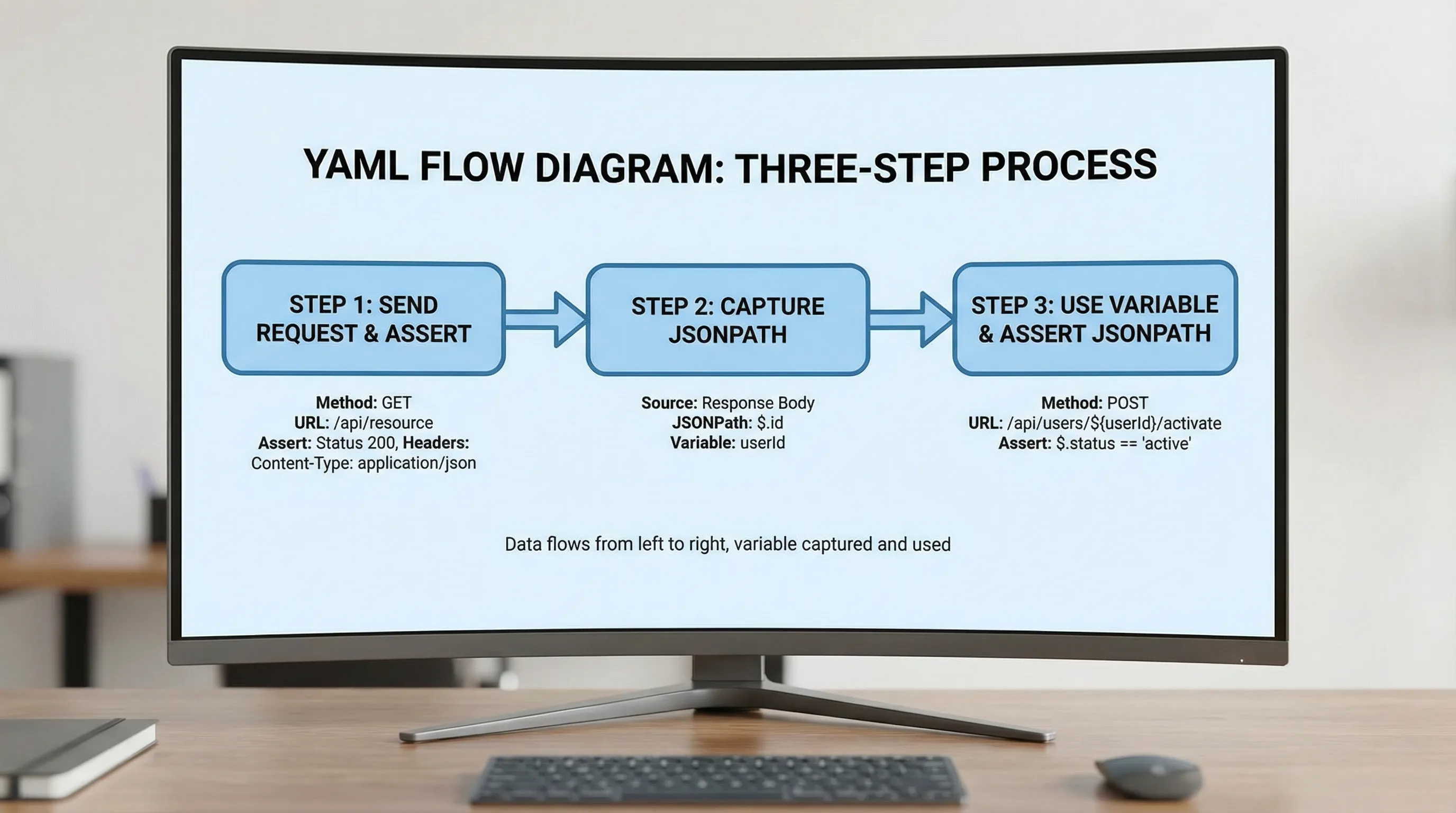
Request chaining is where YAML flows become either beautifully readable or completely opaque.
A pattern that scales is:
- Give each step a clear
nameinside its typed node - Validate responses with
js:nodes before using values downstream - Reference upstream values directly with
{{NodeName.response.body.field}}
Example "login then use token" flow:
flows:
  - name: AuthAndListProjects
    steps:
      - request:
          name: Login
          method: POST
          url: '{{BASE_URL}}/auth/login'
          headers:
            Content-Type: application/json
          body:
            username: '{{USERNAME}}'
            password: '{{PASSWORD}}'

      - js:
          name: ValidateLogin
          code: |
            export default function(ctx) {
              const resp = ctx.Login?.response;
              if (resp?.status !== 200) throw new Error(`Expected 200, got ${resp?.status}`);
              if (!resp?.body?.token) throw new Error("token missing from login response");
              return { validated: true };
            }
          depends_on: Login

      - request:
          name: ListProjects
          method: GET
          url: '{{BASE_URL}}/v1/projects'
          headers:
            Authorization: Bearer {{Login.response.body.token}}
          depends_on: ValidateLogin

      - js:
          name: ValidateProjects
          code: |
            export default function(ctx) {
              const resp = ctx.ListProjects?.response;
              if (resp?.status !== 200) throw new Error(`Expected 200, got ${resp?.status}`);
              const ct = resp?.headers?.["content-type"];
              if (!ct?.includes("application/json")) throw new Error(`Bad content-type: ${ct}`);
              return { validated: true };
            }
          depends_on: ListProjects
This structure makes PR review straightforward: you can see which response field is referenced, where it is used downstream via {{Login.response.body.token}}, and which invariants are enforced in the JS validation nodes.
Making YAML assertions Git-friendly (and CI-friendly)
Assertions only help if reviewers can trust what changed.
A few conventions that keep diffs stable:
- Stable key ordering inside
headers, query params, and assertion blocks - One assertion per line when possible (avoid large inline maps)
- Quote ambiguous scalars (
on,off,yes, numeric-looking strings) to prevent YAML type surprises - Prefer small targeted JSONPath checks over pasting fixtures
This is one of the practical advantages over Postman and Newman: instead of JavaScript test snippets embedded in a collection export, you review declarative assertions in YAML. Bruno moves tests closer to text files, but it still uses its own .bru format and conventions. Native YAML tends to integrate more cleanly with existing tooling (linters, formatters, CI diffs, code owners).
Practical scenarios you should encode as assertions
A few high-value scenarios where status, JSONPath, headers, and timing work together:
Pagination invariants
Assert that pagination headers or body fields are consistent (for example, nextCursor exists when hasMore is true), and that item counts are bounded.
Cache correctness
On a cacheable endpoint:
- First request returns 200 and an
ETag - Second request with
If-None-Matchreturns 304
This is often more meaningful than raw latency assertions.
Backward compatibility on response shape
Instead of asserting “response equals fixture,” assert that:
- New fields are optional
- Old fields are still present
- Types did not change
This prevents accidental breaking changes without freezing the entire payload.
Frequently Asked Questions
Should I assert on the entire JSON response body? Usually no. Whole-body equality is brittle and creates noisy diffs. Prefer JSONPath checks for invariants (presence, type, a few stable values).
What JSONPath flavor should we use? Use a consistent JSONPath implementation across local and CI, and document it. If you need a baseline standard, JSONPath is specified in RFC 9535.
How do I avoid flaky timing assertions in CI? Treat timing as a budget (max_ms) with headroom, and gate strict thresholds post-merge or nightly. Avoid turning performance benchmarking into a PR gate.
Should header assertions include exact Content-Type matches? Only if your API contract requires it. Otherwise assert prefixes or contains checks (for example, application/json) to avoid failing on charset differences.
How is this different from Postman/Newman tests? Postman/Newman typically embed assertions in JavaScript within a collection export, which is harder to diff and review. YAML assertions are declarative and PR-friendly, and DevTools stores them as native YAML flows.
Build assertions you can review, run locally, and trust in CI
If you are moving away from UI-locked API testing, DevTools is designed for the workflow described above: capture real traffic when helpful, convert it into human-readable YAML, review changes in pull requests, and run the same flows locally or in CI.
- Start from a Postman suite: Migrate from Postman to DevTools
- Wire it into CI: API regression testing in GitHub Actions
- Keep YAML diffs clean: YAML API test file structure conventions
For the full guide to YAML-native API testing, including syntax patterns, variable passing, environments, and Git workflows, see: YAML-Native API Testing: Define, Version, and Run Tests as Code.